This past Thursday was the first day of school, and the first day of my second year teaching with 1:1 Chromebooks. I was excited to meet my new students and right away introduced myself as their "geeky, tech-obsessed" teacher and to show them around their new classroom because I have recently acquired a SMART Kapp board and brand new, top of the line SMART Board 6065 (interactive flat panel), so my classroom looks beautiful and super high-tech. I'm really proud of this - I've worked hard to get these things and couldn't be more excited to use these new tools in my classroom.
The first day of school was busy and filled with introductions and paperwork, so there wasn't really time to get out Chromebooks and play, but my students' eyes LIT UP when I told them that I had no problem with them using their cell phones and devices as tools to help their learning! They've never been told this before, but I wanted them to know right away that I'm pro-technology, as long as it's being used appropriately. I think it set a good tone.
The second day we started right off with Chromebooks and after configuring settings and bookmarking some pages, I gave them their first assignment: a fun geography/math/Google search challenge I created in Google Earth Tour Builder. Have you used Tour Builder? If not, it's a fantastic tool from Google Geo that allows you to create a tour made up of stop anywhere in the world. You can add text and photos to each stop for students. The applications for this are endless, but for this first introductory activity, I took students on a tour of world landmarks and asked a question they'd have to answer correctly before being able to go on to the next stop (answers were recorded in a linked Google Form with data validation). Check out my activity here - and even play it yourself! The teachers I shared it with had fun doing it, too!
My students ended the day excited about sixth grade and using technology, and I consider that a successful first week of school.
Teaching is not my job, it’s my passion. Getting better it - that is my job
Sunday, August 9, 2015
Saturday, August 8, 2015
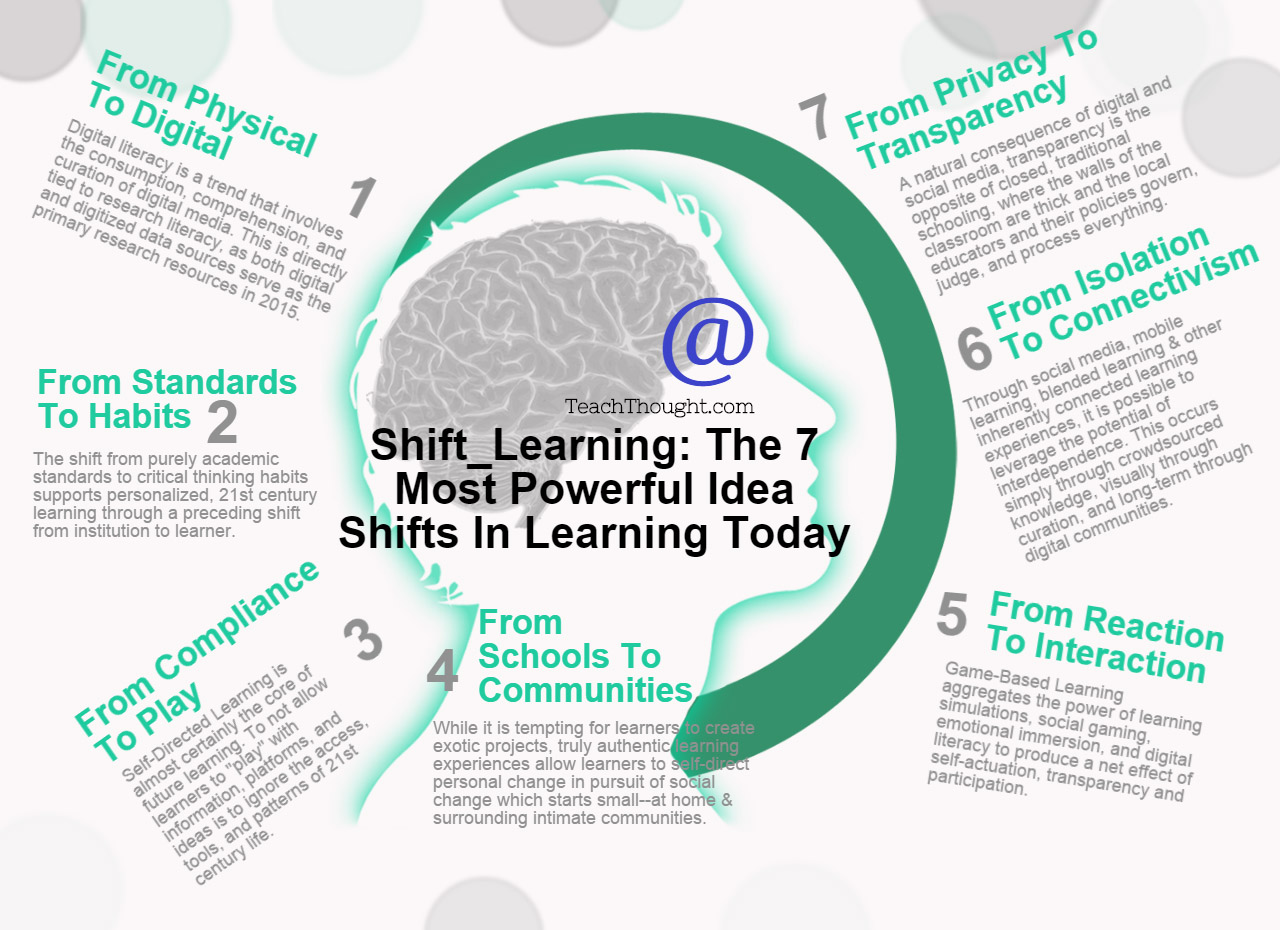
The 7 Most Powerful Idea Shifts in Learning Today
I came across this infographic on Twitter and really liked its ideas. (The full article can be found here). Sometimes, we get so focused on the day to day changes in education - integrating technology into our specific lessons, mastering the new Common Core Standards, getting students to understand a math concept, etc. - that we forget to step back and look at the big picture that drives the small changes in our daily instructional decisions. I agree with all of these and think it's a good reminder of the exciting educational shifts we, as educators, are a part of.
Thursday, August 6, 2015
Class Size
I recently attended a Global Educators Summit hosted by SMART Technologies in Calgary, Canada. There were 77 educators representing 22 countries in attendance, and we spent a week learning from and with each other. One morning over breakfast, the group at my table (10 people - 4 from countries outside the USA, the others were all from different states within the US) began discussing class sizes. I was shocked to find that my class size was significantly higher than everyone else's at my table. I teach sixth grade at an elementary school in California and have, on average, 32-34 students per year (plus those who mainstream in for half the day, so up to 40 bodies in my room). I was so surprised at the low numbers not only in other countries, but in other states as well. It made me sad because I really feel like this is a huge factor in the quality of education students receive. The best teacher in the world can only do so much with 40 students! I remember saying in full sincerity that morning, "Having only 25 students in a class would change my life!"
So out of curiousity, how many students, on average, do you have in your classroom?
Tuesday, August 4, 2015
How to Start a Movement
This is my current favorite TED talk. It's a talk by Derek Sivers about starting a movement. He uses a silly video as a perfect example to show how a movement is made - one person starts something and people look at him like he's crazy, but as soon as the first follower joins in, it becomes a movement and more and more people join. I think the reason I love this video is that I often find myself in the "first follower" role regarding technology in my district. A movement is starting, but it's slow going; this video is encouraging!
Here are some of my favorite points he makes:
- The first follower is an underestimated form of leadership in itself. The first follower is what transforms a lone nut into a leader.
- Followers are often more important than the leader because new followers emulate the followers, not the leader.
- As more people join in, it becomes less risky and there's no reason not to join in.
- We can't all be leaders, so have the courage to follow and show others how to follow.
Monday, August 3, 2015
Bringing History Alive
One of my most successful units last year was on the mystery of Amelia Earhart's disappearance. This is always an engaging unit for students because of its intrinsic mystery. It's built in to part of my nonfiction/informational text unit and we focus on drawing information from a variety of sources and forming and defending opinions based on the evidence we collect. This year, having Chromebooks during this unit added a whole other layer of depth I was thrilled about. Students had much more access to information at their fingertips and were able to examine all sorts of theories about her disappearance. There are countless videos available about her disappearance, but I also encourage students to examine her life before the infamous flight. We take some time to listen to Earhart's famous "The Future of Women in Flying" speech. Students love hearing her voice, and this speech always sparks interesting conversation. You can hear the speech for yourself here:
Sunday, August 2, 2015
Google Cardboard
Today's post is about my new favorite tech "gadget," Google Cardboard. I heard about Google Cardboard some time ago from Twitter and some online forums, but didn't fully get what it was. This past June, I attended the Google Geo Teacher Institute at Google LA in Venice, CA, and got to experience Google Cardboard for myself. WOW, I was instantly in love!

So, what is it, you ask? Well, Cardboard is just that - a piece of cardboard folded into a viewfinder (remember the Viewmaster from when we were kids?) with a magnet and two lenses that make a Virtual Reality (VR) device. You place your device (phone or ipod) into it, run an app (or use Google Maps if you have an Android device) and you're instantly immersed into a VR world where you can look around 360 degrees and even move forward and back, left and right through Google Map's street view of any place in the world, including underwater in places like the Great Barrier Reef! You really have to experience it for yourself!We were fortunate enough to be given on Cardboard from the GTI, and I won a second one in a game we played, so now I have two for my classroom. I haven't figured out exactly how to incorporate them into my teaching just yet, but I'm excited to see what the students think! Maybe virtual field trips to the Great Pyramid and Sphinx when we study ancient Egypt? VR walks through the remains of Pompeii and Herculaneum during our volcano unit? How might you use it?
Wednesday, July 29, 2015
The Middle
This saying has been around for a long time and applies directly to a debate about generational differences between today's youth and the adults who teach them. Marc Prensky views today's "digital natives" (younger generation that has grown up with technology) as a completely different animal than "digital immigrants" (older people who have adopted the culture of technology) and goes so far as to say that their brain structure has changed which directly influences the way they think, process information, and learn. He requires teachers to step up and rethink their teaching styles in ways that will resonate with this new generation of digital natives. However, Prensky's arguments are met with strong disagreement by Jamie McKenzie who calls him out on the basis that his claims are completely unsubstantiated by research, going so far as to claim that Prensky even misused the anecdotal “evidence” that he presents to support his beliefs.
Given these two opposing views, I refer back to the quote above and say that the truth lies somewhere in the middle. Extremes are rarely a good thing, and for Prensky to call for a complete overhaul in teaching to adapt to the culture of digital natives is excessive. For McKenzie to discount all of Prensky's ideas in one fell swoop is equally excessive. I agree with some of Prensky's ideas about the learners of today being drastically different from previous generations, however, I think he took an extremist and oversimplified point of view in his article. He makes some valid points - it is our obligation as educators to constantly find creative ways to engage and teach our students, often having to move out of our personal comfort zones to meet them where they're at - but I strongly disagree that video games are the one size fits all solution to this challenge.
Prensky presents his ideas as an extremist, backed with little empirical evidence, but McKenzie, his antagonist, does the same. In his vehement rebuttal to Prensky's claims, McKenzie comes across as hostile and angry, and while many of his points are valid, he doesn't offer any alternative solutions to the issues at hand; he's seeking only to attack Prenksy and that destructive (as opposed to constructive) approach doesn't make him any more attractive than the claims he seeks to dispel.
Overall, today's learner has changed - their expectations of what school should be and what it takes to engage them is different than in the past due to cultural shift. Whether we call that a culture of digital natives or not is irrelevant. Too much focus is wasted on labels and groupings - people are different, students are different, whether that be based on birth year, identified generation, gender, race, socioeconomic status, etc. We, as educators, need to work to meet students where they're at; we have an obligation to provide the best, most relevant education we can to prepare them for their futures.
Prensky presents his ideas as an extremist, backed with little empirical evidence, but McKenzie, his antagonist, does the same. In his vehement rebuttal to Prensky's claims, McKenzie comes across as hostile and angry, and while many of his points are valid, he doesn't offer any alternative solutions to the issues at hand; he's seeking only to attack Prenksy and that destructive (as opposed to constructive) approach doesn't make him any more attractive than the claims he seeks to dispel.
Overall, today's learner has changed - their expectations of what school should be and what it takes to engage them is different than in the past due to cultural shift. Whether we call that a culture of digital natives or not is irrelevant. Too much focus is wasted on labels and groupings - people are different, students are different, whether that be based on birth year, identified generation, gender, race, socioeconomic status, etc. We, as educators, need to work to meet students where they're at; we have an obligation to provide the best, most relevant education we can to prepare them for their futures.
References:
Prensky, M. (2001). Digital natives, digital immigrants – Part II: Do they really think differently? On the Horizon, 9(6). Retrieved from http://www.marcprensky.com/writing/Prensky%20-%20Digital%20Natives,%20Digital%20Immigrants%20-%20Part1.pdf
McKenzie, J. (2007). Digital nativism: Digital delusions and digital deprivation. From Now On, 17(2). Retrieved from http://fno.org/nov07/nativism.html
Reeves, T.C. (2008). Do generational differences matter in instructional design? Online discussion presentation to Instructional Technology Forum from January 22-25, 2008 at http://it.coe.uga.edu/itforum/Paper104/ReevesITForumJan08.pdf
Subscribe to:
Posts (Atom)